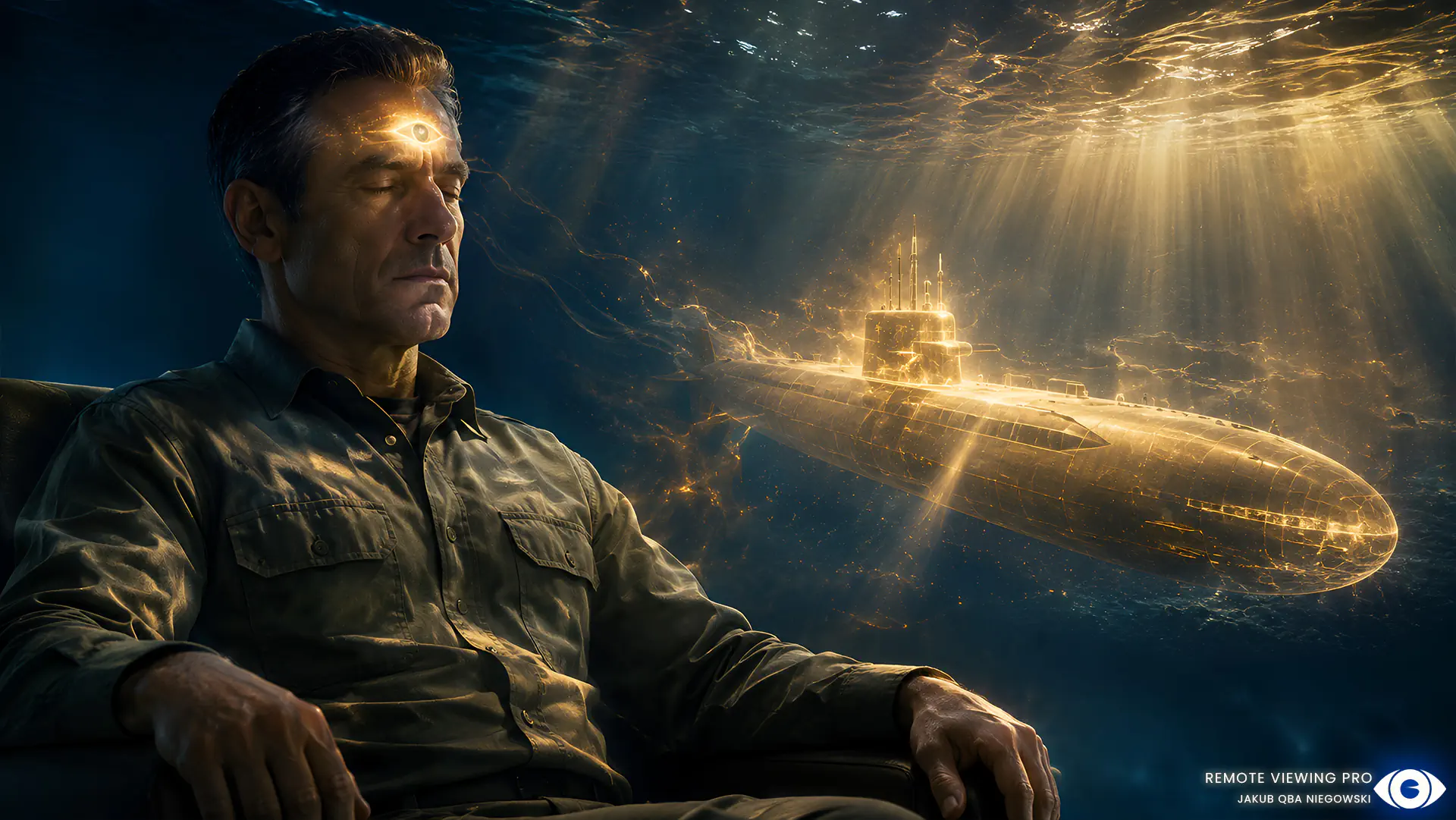

Every so often a skill feels brand new when it is actually very old. Remote viewing is one of those. The structured, laboratory-tested method we use today is only a few decades old, but the underlying human impulse – to perceive what lies beyond the reach of the eyes – runs back as far as recorded history goes. Tracing that long arc does something useful: it shows you that you would not be dabbling in a novelty. You would be joining a tradition.
So let me walk you from the ancient world to the CIA, and show how a faculty once wrapped in mystery became a repeatable, teachable protocol.
Seeing at a distance across ancient cultures
Long before anyone spoke of extrasensory perception, cultures around the world built entire institutions around people who claimed to perceive the distant and the hidden. The oracle at Delphi advised kings and generals on matters far away. Shamans across Siberia, the Americas, and Australia were tasked with locating game, missing people, and the source of an illness, often describing places they had never physically traveled to.
Scrying – gazing into water, polished metal, or a crystal to receive impressions – appears independently in dozens of societies, which is itself telling. When unrelated cultures keep inventing similar practices, it usually points to a shared human experience underneath the ritual. These traditions were wrapped in religion and ceremony, and their methods were not rigorous by modern standards. But the core activity is unmistakably familiar: quieting the mind, attending to subtle impressions, and reporting information about something out of sight.
I am not claiming an oracle was running clean blind protocols. I am pointing out that the raw human capacity remote viewing draws on has been noticed, valued, and put to work for thousands of years.
The twentieth-century leap: parapsychology meets physics
The decisive shift was not the discovery of the ability. It was the decision to test it properly. In the late nineteenth century, societies for psychical research began trying to study these phenomena with scientific discipline rather than faith. By the 1930s, researchers like J. B. Rhine at Duke University were running controlled card-guessing experiments and applying statistics to the results, dragging the topic out of the séance room and toward the laboratory.
This was the era when the modern vocabulary took shape – terms like clairvoyance and extrasensory perception were given working definitions and tested rather than simply asserted. The results were debated fiercely, as they still are, but a crucial corner had been turned. What had always been treated as a mystical gift was now being approached as a natural phenomenon that could, at least in principle, be measured.
Stanford, the military, and the modern era
The story then arrives at its most cinematic chapter. In the early 1970s, at the Stanford Research Institute, physicists Harold Puthoff and Russell Targ began working with a gifted artist named Ingo Swann. Swann was not content to be a test subject. He pushed the researchers to design a more disciplined approach, one that ordinary people could be trained in rather than a talent only a few possessed.
The implications did not escape the intelligence community. Against the backdrop of the Cold War, with rumors that the Soviet Union was investing in psychic research of its own, the United States government began funding the work. Over the following two decades the effort moved through several code names and a secret unit based at Fort Meade, eventually remembered under the umbrella name Stargate. Trained viewers were tasked against real intelligence targets – installations, vehicles, missing aircraft, hostages. Some of their results were striking enough to keep a skeptical bureaucracy paying the bills for twenty years.
In 1995 the program was declassified, and close to ninety thousand pages of files entered the public domain. Overnight, a guarded military method became something the rest of us could read about, study, and eventually learn.
How remote viewing became a teachable skill
The quiet revolution inside this history is the one most people miss. The pioneers did not just demonstrate that perception at a distance was possible. They built a structure for it. Ingo Swann’s great contribution was a staged protocol – later known as Coordinate Remote Viewing – that gave the chaotic, intuitive experience a reliable scaffolding. Steps, checks, and a clear sequence turned a flash of talent into something repeatable.
That is what separates the modern era from every century that came before it. The Delphic oracle could not hand you a method. A shaman’s gift was personal and largely untransferable. But a structured protocol can be taught, practiced, corrected with feedback, and improved. The ancient seers had the experience. The twentieth century gave it an instruction manual. For the first time, perceiving at a distance stopped being something you were born able to do and became something you could learn to do.
That shift is the entire reason this website exists, and it is why a curious beginner today stands on ground the oracles never had. If you want to start where that long tradition now leads, our free remote viewing eBook gives you a grounded introduction to the foundations, distilled from the modern method rather than ancient guesswork.
The Cold War psychic arms race
It is hard to understand why a government would pour money into perception experiments without picturing the era that produced them. The Cold War was a contest of paranoia as much as missiles, and intelligence on both sides took seriously the possibility that the other was developing exotic capabilities. Reports – some accurate, some inflated – suggested the Soviet Union was investing heavily in parapsychology and what they called psychotronics. No serious agency wanted to be the one that ignored a real advantage because it sounded strange.
That fear created room for the work to be funded properly rather than dismissed. The logic was coldly practical: if there was even a modest chance that trained viewers could describe a installation behind closed borders or a submarine under construction, the cost of testing it was trivial next to the potential payoff. This is why remote viewing developed inside a security apparatus rather than a university psychology department. The pressure to produce real, checkable intelligence forced a level of rigor and accountability that a purely academic setting might never have demanded – and it is part of why the surviving protocols are as disciplined as they are.
Why the history matters for you
It would be easy to read all this as trivia. It is more than that. Knowing the lineage changes how you approach your own practice. You are not chasing a fad invented to sell courses. You are picking up a thread that ancient cultures intuited, that early scientists fought to test, that physicists refined, and that a government trusted with real stakes. That context lends the practice a seriousness it deserves – and it quietly answers the nagging doubt that you might be wasting your time on something frivolous.
What I find quietly moving about this lineage is how it collapses the distance between an ancient seer and a curious person opening a laptop today. The tools changed, the ceremony fell away, and guesswork was replaced by method, but the essential human act stayed the same: turning attention toward the unseen and trusting what comes back. You are not standing at the end of that story as a spectator. You are its newest chapter, with better instructions than anyone before you ever had. If you want the plain version of what that practice involves, start with what remote viewing is and how it works, then let the history give it depth.
Frequently asked questions
How old is remote viewing?
The structured modern method dates to the 1970s, but the underlying human practice of perceiving distant or hidden things runs through ancient oracles, shamans, and scrying traditions worldwide. The faculty is old; the protocol is recent.
Who invented modern remote viewing?
It emerged at the Stanford Research Institute through the work of physicists Harold Puthoff and Russell Targ, with the artist Ingo Swann playing a central role in shaping the staged protocol that made the skill teachable.
When was remote viewing declassified?
The United States government declassified the program in 1995, releasing close to ninety thousand pages of documents that are now part of the public record.
Was remote viewing really used by the military?
Yes. For roughly two decades it was funded as a real intelligence effort, with trained viewers tasked against operational targets from a unit based at Fort Meade under names that became known collectively as Stargate.
Jakub Qba Niegowski – Extrasensory Consciousness Development Specialist