
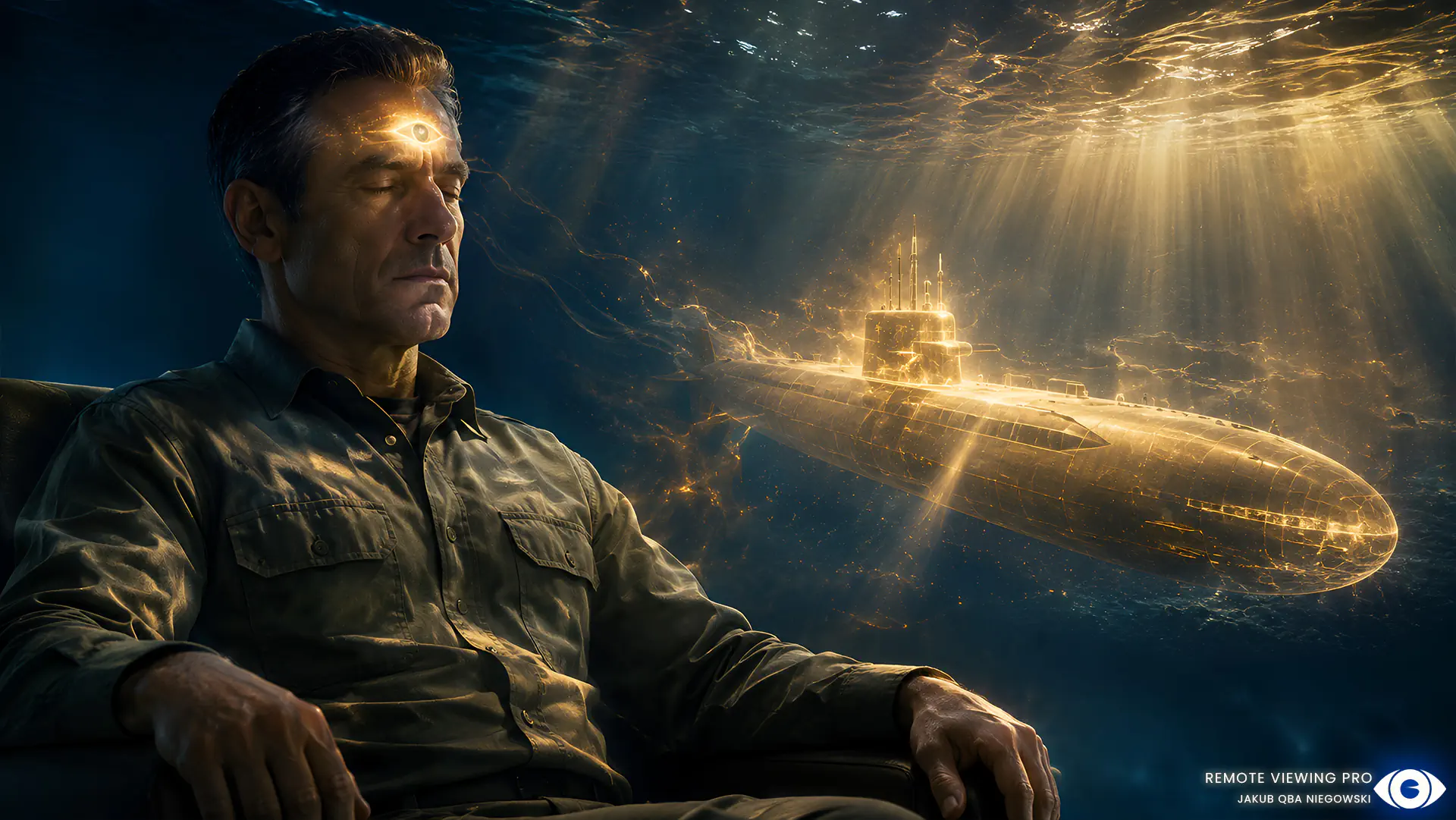
If you want a single human story that captures what remote viewing can become, it is hard to beat Joseph McMoneagle. He was not a mystic or a stage performer. He was a career Army intelligence officer who, through training and an unusual turn of fate, became the most documented psychic spy in American history – known inside his secret unit simply as Remote Viewer 001.
His career matters because it answers the question every newcomer secretly asks: can an ordinary person really get good enough at this for it to mean something? McMoneagle’s life says yes, and the official medal pinned to his chest says it in the government’s own words.
From soldier to legendary psychic spy
McMoneagle’s path into remote viewing did not begin in a laboratory. It began, by his own account, with a near-death experience in 1970 while he was stationed overseas. Collapsing outside a restaurant, he felt himself leave his body and observe the scene from outside it. The episode rattled and changed him, opening a sensitivity to perception beyond the ordinary senses that he had never paid attention to before.
Years later, when the Army went looking for candidates for its experimental remote viewing unit at Fort Meade, McMoneagle was an obvious fit: a disciplined intelligence professional who also happened to have a natural openness to the experience. He became one of the original members of the program in the late 1970s. Crucially, he did not rely on raw talent. He trained, practised, and submitted to the same structured protocols as everyone else, which is exactly why his results were taken seriously rather than dismissed as lucky guesses.
The Soviet submarine he saw before the satellites
The case most often told about McMoneagle is also one of the most striking in the entire Stargate record. In 1979 he was tasked against a target he knew nothing about – a large building in the Soviet Union, set oddly far from any coastline. Describing his impressions on paper, he reported an enormous structure inside, something like a massive submarine, far bigger than anything then known, with a double hull, around twenty angled missile tubes, and a strange slanted ramp leading toward distant water.
The analysts were sceptical. A submarine that size, built inland, made little sense by what was then understood. McMoneagle also sensed it would be launched within a few months. In mid-January of 1980, satellite imagery confirmed the picture: a new and previously unknown class of vessel, later designated the Typhoon, the largest submarine ever built, complete with the unusual features he had described. He had perceived, from a quiet room, a state secret that the most expensive surveillance technology of the era had not yet pieced together.
Hundreds of intelligence targets
The submarine was not a one-off. Over roughly two decades, McMoneagle contributed to an enormous number of operational sessions – hundreds upon hundreds of taskings against the kinds of targets that conventional intelligence struggled to reach. Concealed facilities, foreign technology, the whereabouts of people and aircraft: he was put to work on the blind spots, the questions other methods could not answer.
Not every session was a triumph, and he has always been candid about that. Remote viewing produces signal mixed with noise, and even the best viewer is accurate much of the time rather than all of it. What set McMoneagle apart was consistency under real conditions – enough verified hits, on serious matters, to make him a trusted resource rather than a curiosity. That track record, built session by session over years, is the very definition of mastery in this field.
A Legion of Merit for information unavailable elsewhere
The clearest proof of his work is not a believer’s testimony but a government decoration. In 1984, McMoneagle was awarded the Legion of Merit, one of the United States military’s significant honours, in recognition of his service. The citation credited him with producing critical intelligence – information, in the official phrasing, that was unavailable from any other source.
Sit with that for a moment. A branch of the armed forces formally rewarded a man for intelligence gathered through perception alone. You can argue about interpretation, but you cannot easily argue with a medal awarded by a sceptical institution that had every reason to be cautious. It remains one of the most concrete pieces of evidence that trained remote viewing produced real, usable results.
What made him so accurate
It is tempting to chalk McMoneagle’s results up to a special gift, but he has always pointed elsewhere: to method and discipline. The hardest part of remote viewing is separating genuine perception from the mind’s eager guessing, the analytical overlay that rushes in to label everything before the real signal has arrived. McMoneagle became a master at catching that interference and setting it aside, recording the raw, strange impressions and resisting the urge to interpret too soon.
He also treated the work like a profession rather than a performance. He logged everything, welcomed feedback even when it stung, and used every miss as information about how to improve. That unglamorous, almost clinical patience is what turned a sensitive man into a reliable instrument. It is also the most useful thing a beginner can take from his example: accuracy is built through honest, repeated practice, not summoned by raw talent.
A life spent putting it on the record
What I find most admirable about McMoneagle is that he never retreated into mystery once the secrecy lifted. He could have let the legend speak for itself. Instead he kept testing his ability in the open, submitting to controlled demonstrations and documented experiments, including public challenges where the conditions were tight and the chance of embarrassment was real.
He worked with serious consciousness researchers, wrote candidly about both his hits and his limits, and refused to oversell what remote viewing can do. That willingness to be measured in public, decades after he had nothing left to prove, is part of why his testimony carries weight. He behaved less like a guru and more like a witness, and witnesses who keep showing up under scrutiny are exactly the kind worth listening to.
What his story means for you
After the program closed, McMoneagle did not vanish. He wrote books, worked with respected consciousness researchers, and submitted to public, controlled demonstrations of his ability, continuing to put his skill on the record rather than hiding behind classified walls. He became, in effect, a living bridge between the secret era and the open one.
The lesson of his life is genuinely encouraging. He was a regular soldier who learned a structured skill and pursued it with discipline until he reached the top of his field. He was trained, not simply born gifted. That is the whole promise of remote viewing as something you can learn rather than merely admire. If his story makes you want to test your own potential under proper guidance, our live online remote viewing training puts you in real, structured sessions, the same disciplined approach that turned an ordinary officer into Remote Viewer 001. To see the wider program he worked within, it is worth reading about the CIA’s Project Stargate as well.
Not a one-off wonder
It would be easy to treat the submarine case as a single lucky strike, but that misreads McMoneagle’s career. The reason he became a trusted asset rather than a curiosity was the breadth of his work over many years – session after session against difficult targets, enough verified results among them to keep serious people relying on his perception. Intelligence professionals do not build a long working relationship around one fluke. They build it around a track record, and his was long enough, and checkable enough, to earn a formal military decoration. That sustained reliability, far more than any single dramatic hit, is what makes his example so instructive for anyone learning the skill today.
Frequently asked questions
Who was Joseph McMoneagle?
He was a United States Army intelligence officer and one of the original remote viewers in the government’s Stargate program, known as Remote Viewer 001. He is the most documented psychic spy in American history and later became an author.
What is McMoneagle most famous for?
His best-known case is the 1979 description of a giant Soviet submarine being built inland, with details matching the previously unknown Typhoon class, which satellite imagery confirmed in early 1980.
Did Joseph McMoneagle really receive a Legion of Merit?
Yes. He was awarded the Legion of Merit in 1984 for providing critical intelligence that the citation described as unavailable from other sources, an unusually concrete official endorsement of his work.
Was McMoneagle born with his abilities?
He traces his sensitivity to a near-death experience in 1970, but his operational skill came from training and disciplined practice under the program’s structured protocols, not from raw talent alone.
Jakub Qba Niegowski – Extrasensory Consciousness Development Specialist