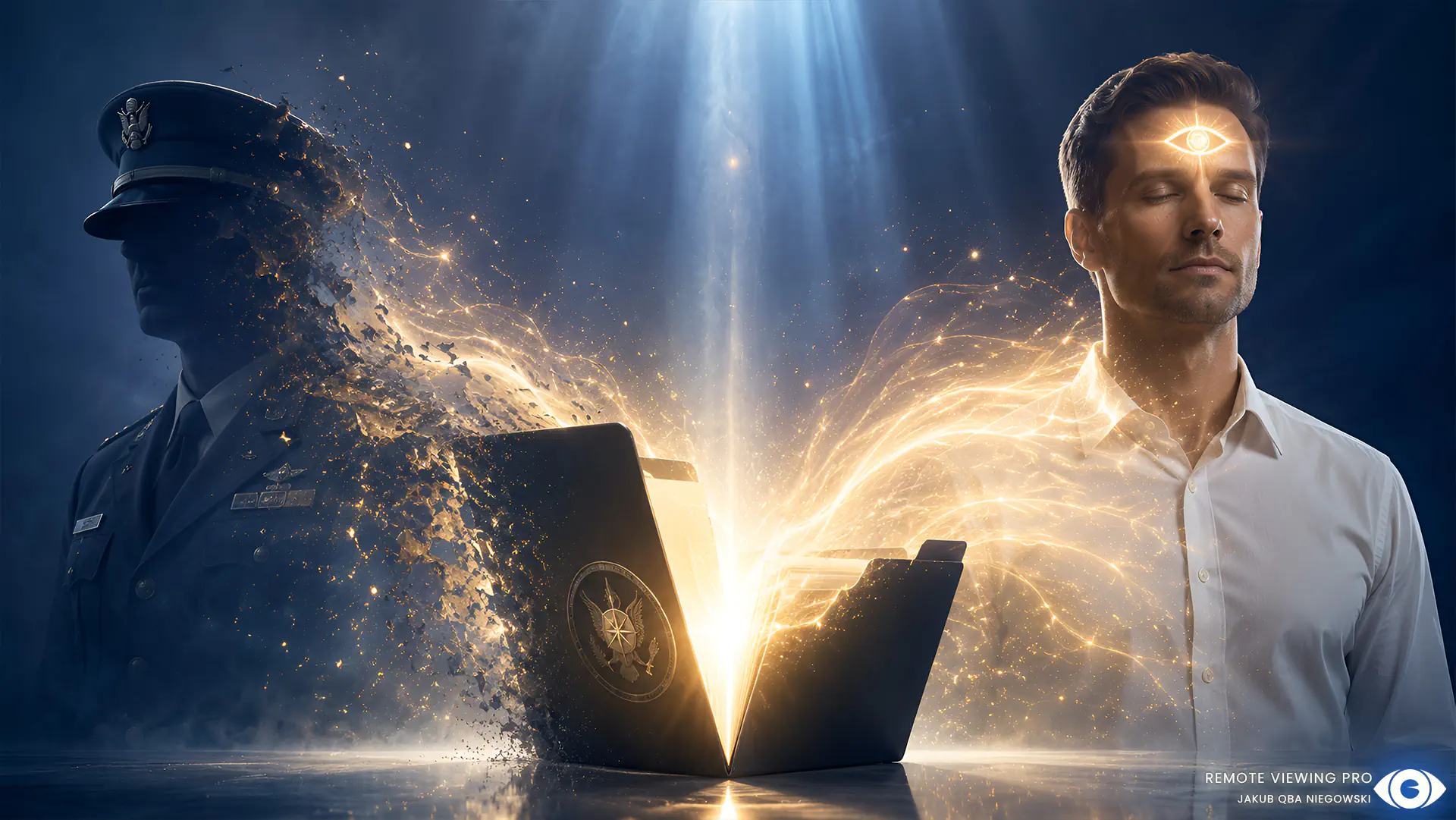
There is a moment in the history of remote viewing that quietly changed everything for ordinary people, and it has nothing to do with a dramatic session or a famous viewer. It happened on paper, in 1995, when the United States government declassified its long-running remote viewing program and opened the files to the public. In that act, a state secret became a public inheritance.
Most people misread what happened next. The headlines said the government had “shut down its psychic program,” and the casual takeaway was that the whole thing had been exposed as nonsense. The reality is more nuanced, more honest, and far more interesting – and understanding it changes how you see the entire field.
The 1995 release of the files
By the mid-1990s, the program had passed through various agencies and was up for review. An independent evaluation was commissioned to assess whether the work had genuine value, and on the back of that process the program was formally closed and its records declassified. Close to ninety thousand pages of material – transcripts, protocols, reports, and assessments – were cleared for public release.
This was not a small leak or a single document. It was the opening of an entire archive built over roughly two decades. For the first time, anyone could see what the program had actually done, how it had worked, and what its own internal assessments concluded. The veil that had kept remote viewing inside the world of classified intelligence was lifted in one stroke.
Why the program was actually closed
The reason for the closure is the most misunderstood part of the story, so it deserves to be stated plainly. The independent review reached genuinely split conclusions. The statistician brought in to examine the data concluded that the effect was real, statistically significant, and consistent across laboratories. The skeptical reviewer agreed the statistics were unusual but argued the methods needed further independent replication before acceptance.
Crucially, the program was wound down over questions of practical intelligence usefulness and management, not because anyone proved the perception was fake. “Not reliable enough for day-to-day spycraft” is a very different verdict from “it does not exist,” yet the two are constantly blurred together. Read the actual conclusions and you find an open scientific question, not a debunking. That distinction is the single most important thing to carry away from 1995.
What the public records actually contain
So what is in those ninety thousand pages? A great deal more than curiosity-seekers expect. There are session transcripts showing viewers’ raw impressions and sketches. There are descriptions of operational taskings against real intelligence targets. There are training materials and methodological notes. And there are internal evaluations, both glowing and critical, written by people with no incentive to flatter the program.
Taken together, the archive is a rare thing: a long, documented, government-funded study of human perception, warts and all. It records the hits and the misses, the breakthroughs and the dead ends. For a serious student, this honesty is a gift. You are not asked to take anyone’s word for what remote viewing can do. The primary record is open, and much of it is now searchable online through the agency’s own reading room.
From military secret to a skill anyone can learn
The most profound consequence of declassification was unintended. By releasing the protocols and the proof of concept, the government effectively handed the public a working method. What had been the exclusive property of a secret unit became knowledge that researchers, teachers, and curious individuals could study and build upon.
This is why a person today can learn remote viewing at all. The structured approaches developed inside the program, refined over years at taxpayer expense, are the direct ancestors of the training available now. The barrier was never that the skill could not be taught to civilians. The barrier was secrecy, and in 1995 that barrier came down. What remained was a teachable discipline, sitting in the open, waiting for anyone willing to learn it.
Standing on the pioneers’ shoulders
There is something quietly moving about this for a beginner. When you sit down to learn remote viewing today, you are not starting from scratch or trusting a salesman’s promise. You are inheriting the refined work of physicists, military viewers, and researchers who spent decades figuring out what works and what does not, often under intense pressure and scrutiny.
Every false start they corrected, every protocol they tightened, every hard lesson they learned is baked into the methods you can study now. The pioneers did the difficult, uncertain groundwork. You get to begin where they left off, which is an enormous and underappreciated advantage. Few skills come with such a well-documented foundation handed to the newcomer for free.
What this means for the curious today
The declassification reframes remote viewing from a piece of Cold War folklore into a living, learnable practice with an unusually transparent pedigree. You can read the original files. You can see the controls, the results, and the honest internal doubts. And then you can pick up the method and try it for yourself, which is where reading ends and real understanding begins.
If the story of 1995 leaves you wanting to explore what those files describe, the natural next step is a grounded introduction to the fundamentals. Our free remote viewing eBook distils the foundations into plain language for the curious beginner. And to understand the program whose declassification made all of this possible, it is worth reading about the CIA’s Project Stargate.
What the review actually said
Because the 1995 closure is so often misrepresented, the details of the review deserve a closer look. The evaluation leaned on two expert voices reaching different conclusions from the same data. The statistician concluded that the remote viewing effect was statistically robust, replicated across laboratories, and could not reasonably be explained by chance. The skeptical reviewer accepted that the statistics were anomalous but held that methodological concerns meant the case was not yet closed and required further independent replication.
Notice what neither of them said. Neither concluded that the phenomenon had been shown to be imaginary. The disagreement was about how firmly the effect had been established, not about whether anything was happening at all. That is a debate about strength of evidence, the ordinary stuff of science, and it is a world away from the popular story that the program was exposed as a hoax.
Reading the files for yourself
Perhaps the best consequence of declassification is that you need not take my summary on trust. The archive is public. Through the agency’s online reading room you can search the records, open actual session transcripts, and see the viewers’ raw impressions and sketches alongside the assessments of the people who ran the program. It is a rare chance to examine a controversial subject through primary sources rather than second-hand opinion. For a curious, honest mind, that open record is worth far more than anyone’s confident verdict, mine included.
A quiet turning point for everyone
It is worth stepping back to feel the weight of what 1995 represents. Most government secrets, when declassified, become history – interesting to read about, but finished. The remote viewing files were different. They did not just describe something that had happened; they handed over a working capability, complete with the methods to develop it. The declassification did not close a chapter so much as open one for the public.
That is why this date belongs in any honest account of how remote viewing reached ordinary people. Before 1995, learning the skill meant somehow gaining access to a classified world. After it, the knowledge was simply there, in the open, for anyone curious enough to pick it up. The transformation from secret weapon to public skill is one of the more unusual stories in the history of human knowledge, and it is the reason a beginner today can begin at all.
Frequently asked questions
When was remote viewing declassified?
The United States government declassified its remote viewing program in 1995, releasing close to ninety thousand pages of documents into the public record at the same time the program was closed.
Why did the CIA declassify the remote viewing program?
The program was reviewed, then closed over questions of practical intelligence value and management, and its records were declassified. Importantly, closure followed a split assessment, not a finding that the phenomenon was fake.
Can I read the declassified remote viewing files?
Yes. The documents were released into the public record and much of the archive is now searchable online through the CIA’s reading room, including session transcripts and program reports.
Does declassification mean remote viewing was proven real?
It does not settle the scientific debate, but the released review included a statistician who judged the effect real and replicable. The files present an open question and a documented record rather than a debunking.
Jakub Qba Niegowski – Extrasensory Consciousness Development Specialist