
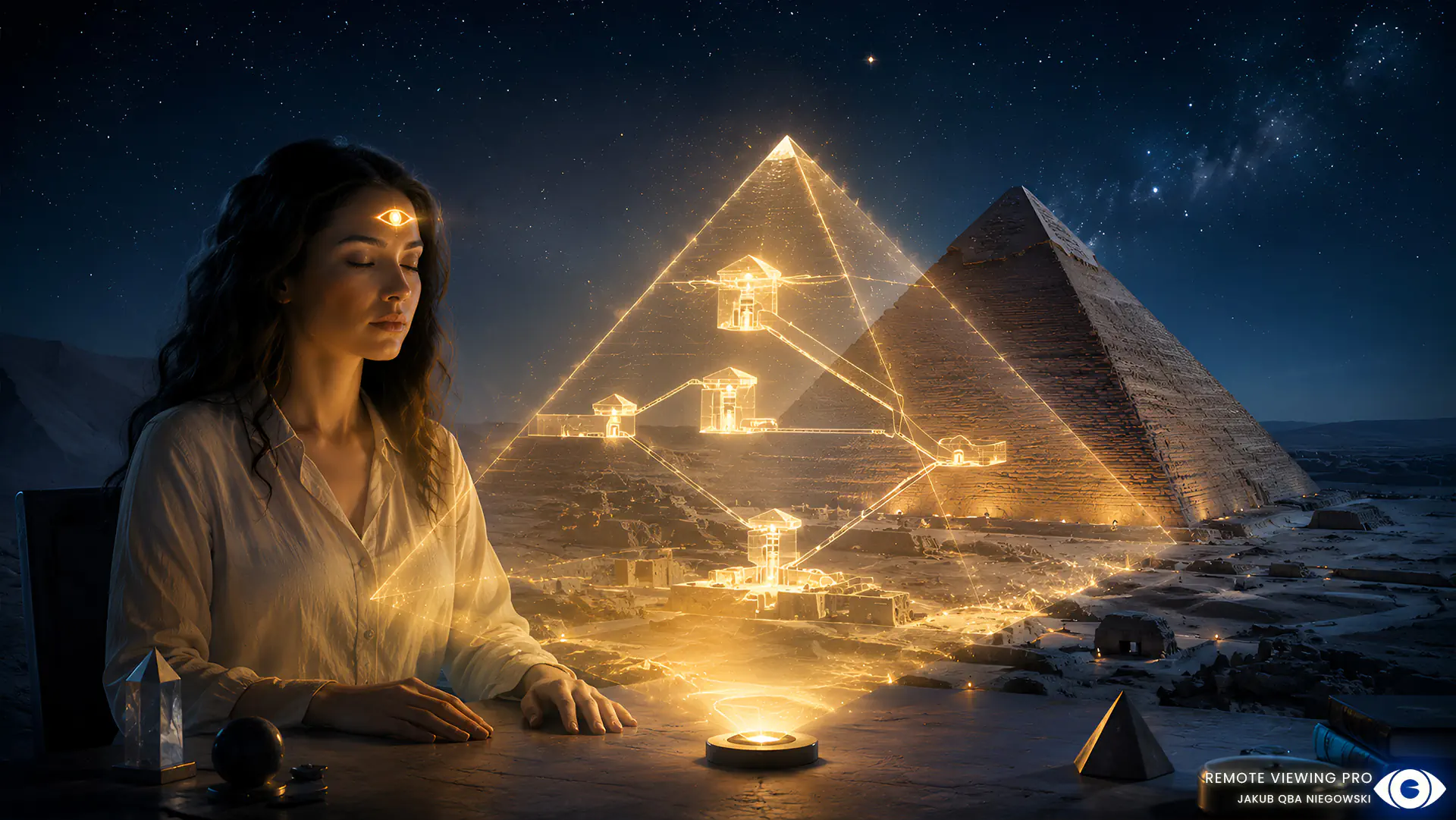
For more than four thousand years, the Great Pyramid of Giza has stood as humanity’s most enduring riddle in stone. We know a great deal about it, and yet it never quite stops asking questions. How exactly was it built with such precision? What did its creators truly intend it to be? Standing before it, even the most rational visitor feels the pull of mystery. It is no surprise, then, that the Great Pyramid has become one of the most compelling targets in the history of remote viewing.
This article explores what happens when trained perception is turned toward that ancient monument. I want to do it honestly, respecting both the genuine knowledge of archaeology and the open questions that remain, while showing why a structure like this is such an irresistible target for the perceiving mind.
What we genuinely know, and what we don’t
Let me start on solid ground, because credibility matters. Mainstream archaeology has strong, well-supported answers about the Great Pyramid. The scholarly consensus holds that it was built around four and a half thousand years ago as a monumental tomb for the pharaoh Khufu, raised by a large, organised workforce of skilled laborers rather than by slaves or by anything supernatural. This is supported by real evidence, and I have no interest in pretending otherwise.
And yet, around the edges of that consensus, genuine questions linger. The sheer precision of the construction, the exact methods used to move and place enormous stones, the purpose of certain internal features and shafts, and the deeper symbolic intentions of the builders are all still debated, some more open than others. It is in these genuinely unsettled spaces, not in fantasies that ignore the evidence, that remote viewing offers an intriguing additional lens.
Why this mystery suits remote viewing
Certain targets seem almost made for remote viewing, and the Great Pyramid is a prime example. It is a place where conventional investigation has reached real limits. We cannot interview its builders, cannot watch its construction, cannot directly access the minds and intentions of the people who raised it. The ordinary tools of history fall silent at exactly the questions that fascinate us most.
This is precisely the kind of gap where perception offers a different way in. Remote viewing is not bound by time in the way excavation is, and in principle a viewer can turn their attention toward the pyramid as it was, toward the people who built it, toward the intentions behind it. It does not replace archaeology, but it can approach the questions archaeology cannot reach and offer impressions to sit alongside the physical evidence. A monument this rich in unanswered human meaning is a natural magnet for the perceiving mind.
What viewers have perceived about its purpose
When viewers turn toward the Great Pyramid, the question of purpose looms largest. The tomb explanation is well supported, yet the pyramid’s staggering scale and precision have long made people wonder whether it served other functions too. Remote viewing sessions have explored this, with viewers reporting impressions of the structure’s intended uses and the meaning it held for those who built it.
I want to be careful here, because this is exactly where credulity can run wild. Impressions about purpose are not proof, and a viewer’s sense of meaning cannot be checked the way a buried wall can. What such sessions offer is not a verdict but a perspective, a set of perceived impressions to consider thoughtfully alongside everything else we know. Held that way, with appropriate caution, they add texture to our wondering rather than false certainty.
Builders, methods, and the human story
Some of the most evocative remote viewing of the pyramid focuses not on grand theories but on the human reality of its creation. Viewers have sought to perceive the builders themselves, the atmosphere of the great project, the labor and organisation and feeling of the enterprise. This is, in a way, the most fitting use of perception applied to history: not to settle technical debates, but to reach toward the lived experience of the people involved.
There is something deeply moving in the attempt. Whatever you make of the accuracy, the impulse to perceive the men and women who hauled and placed those stones, to sense the scale of their effort and devotion, restores a human dimension that bare archaeology can lose. The pyramid stops being a problem to be solved and becomes, for a moment, a living undertaking carried out by real people with real purposes. That shift in perspective is part of what makes this kind of viewing so affecting.
The temptation to overclaim
An honest article about pyramid remote viewing has to confront the field’s biggest danger: the temptation to overclaim. The Great Pyramid attracts more than its share of wild theories, and remote viewing has sometimes been used to lend false authority to fantasies about lost super-civilisations and impossible technologies. I have no patience for that, because it discredits both serious archaeology and serious remote viewing at once.
The responsible position is disciplined and humble. Remote viewing impressions of the pyramid are unverifiable, and they should be presented as perceptions to ponder, never as established facts that overturn the evidence. A viewer sensing something about the monument is offering a perspective, not a proof. Keeping that distinction sharp is what separates credible exploration from the sensationalism that has done this subject so much harm.
The experience of viewing an ancient wonder
Beyond any claim about results, there is the experience itself, and it is profound. To turn your trained attention toward a structure that has stood for four millennia, to reach across that vast gulf of time toward the people who built it, is to feel history collapse into something almost immediate. Practitioners often describe a deep sense of connection and awe when working such ancient targets.
This is part of why monuments like the Great Pyramid hold such a draw for viewers. The practice transforms a distant wonder from a thing you read about into something you reach toward with your own perception. Whether or not any single impression is accurate, the encounter expands your sense of connection to the deep human past, and that experience of touching history with the mind is genuinely moving in its own right.
Holding wonder and rigor together
The Great Pyramid teaches the same lesson that runs through all serious remote viewing: that wonder and rigor belong together. You can be genuinely captivated by the mystery of this monument while still respecting the evidence, refusing to overclaim, and treating perceived impressions with honest caution. The two are not in conflict; the discipline is what keeps the wonder trustworthy.
That balance is, in the end, the healthiest way to approach every great enigma. Stay open enough to perceive something remarkable, disciplined enough to test it honestly, and humble enough to admit what cannot be verified. Applied to the oldest wonder of the ancient world, that posture turns idle speculation into thoughtful exploration.
Exploring the mysteries for yourself
The Great Pyramid is just one of many ancient mysteries that draw the perceiving mind, and it sits at the heart of a whole family of fascinating case studies. The same approach can be turned toward countless enigmas of the past and present, each offering its own blend of wonder and challenge.
If a particular mystery captivates you and you would like it explored through trained perception, this is specialised work best handled by an experienced viewer who understands both the fascination and the discipline it demands. You can request a session from a trained remote viewer, who can approach an enigma like this with the rigor and honesty it deserves. The mysteries are endless, and perception offers a remarkable way to reach toward them.
Frequently asked questions
Has the Great Pyramid been remote viewed?
Yes, it has been a popular target for remote viewers exploring its purpose, builders, and meaning. The resulting impressions are unverifiable and should be treated as perspectives to consider alongside archaeology, not as established facts.
Does remote viewing contradict mainstream archaeology about the pyramid?
Not necessarily. Mainstream archaeology has strong evidence that it was a tomb built for Khufu by skilled workers. Remote viewing explores the genuinely open questions around the edges, offering impressions rather than overturning the established evidence.
Can remote viewing prove how the pyramid was built?
No. Remote viewing impressions cannot be verified the way physical evidence can, so they cannot prove construction methods. They can offer perceived perspectives to ponder, but credible practice presents these with caution, never as proof.
Why is the Great Pyramid such a popular remote viewing target?
Because it combines deep mystery with questions conventional investigation cannot fully reach, like the intentions of its builders. Its age and grandeur also make it an emotionally powerful target for perceiving the distant human past.
Jakub Qba Niegowski – Extrasensory Consciousness Development Specialist