The universe is full of objects so strange, so distant, and so extreme that even our most powerful instruments can barely glimpse them. A mysterious visitor from another star system that tumbled through our solar system and vanished. A supermassive black hole lurking at the heart of our galaxy. Comets, anomalies, and enigmas scattered across the void. These are the ultimate unreachable targets, and they raise a dizzying question: if perception is not bound by distance, could a trained mind reach toward the deepest mysteries of space itself?
This is the most speculative frontier in all of remote viewing, and I want to explore it with equal parts wonder and rigorous honesty. Let me take you to the edge of the cosmos and the edge of what the practice can credibly claim.
Aiming perception at deep-space targets
Deep space presents the most extreme version of remote viewing’s central premise. If a viewer can perceive a building across the world or a planet across the solar system, then in principle nothing is too far, not an object beyond Neptune, not the centre of the galaxy, not the strangest phenomena astronomers have detected. The same perception that reaches a hidden room might, at full stretch, reach across light-years.
The appeal is obvious. These are targets we can never visit and can barely observe, known to us only through faint signals and brief glimpses. If remote viewing could add anything to our understanding of them, it would be reaching where no spacecraft will travel for millennia, if ever. This is exploration at its most audacious, the mind cast toward objects at the very limits of human knowledge. Whether it genuinely works at such extremes is deeply uncertain, but the ambition alone captures something essential about human curiosity.
Oumuamua, Sagittarius A and other enigmas
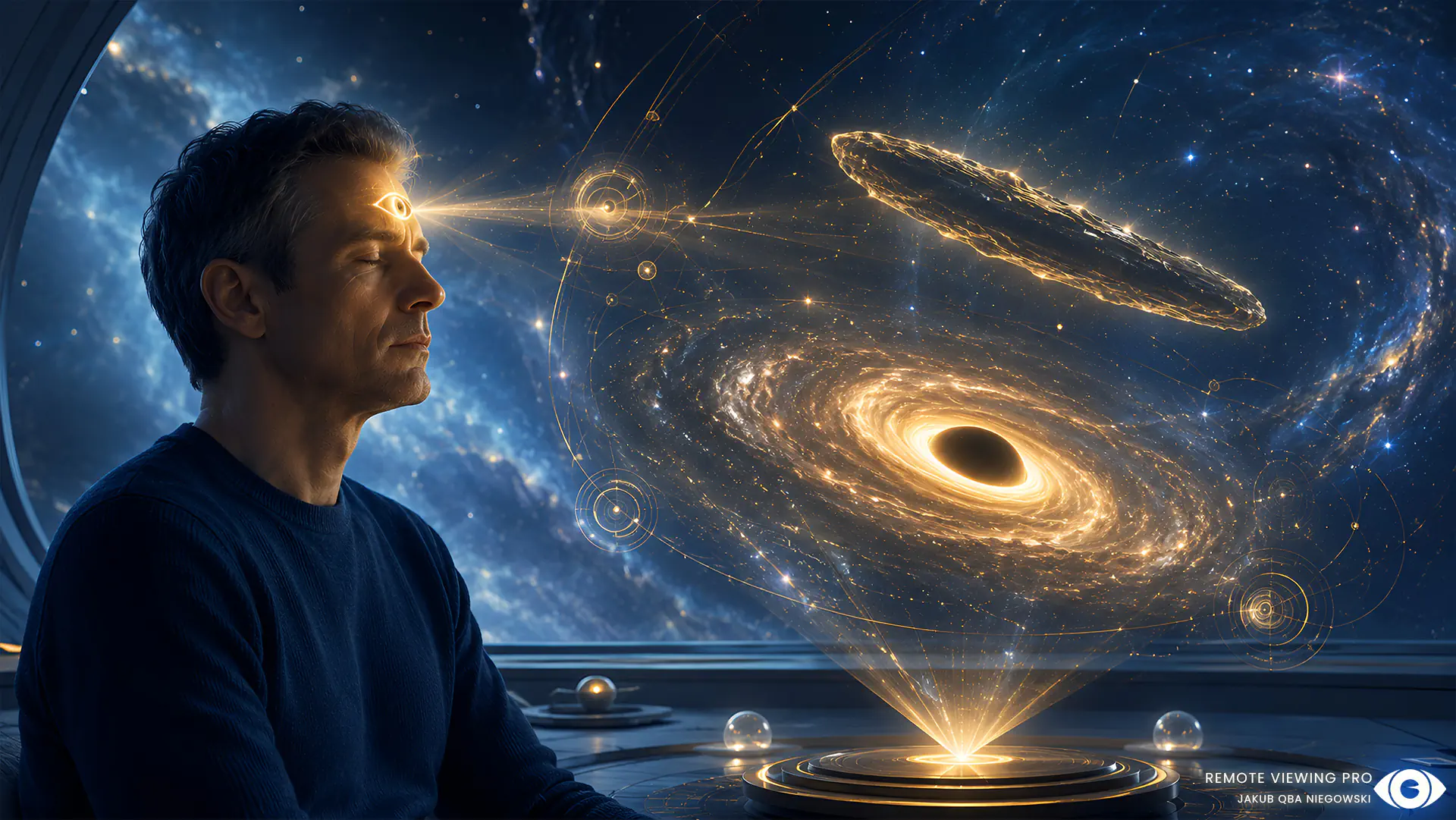
Consider the kinds of targets that draw cosmic viewers. In 2017, astronomers detected the first confirmed interstellar object passing through our solar system, an elongated body from beyond our star that behaved oddly enough to spark serious scientific debate about its nature. It was observed only briefly before racing back into the dark, leaving more questions than answers, the perfect enigma.
At the centre of our galaxy lies a supermassive black hole, a region of such extreme physics that it warps space and time and swallows light itself, now confirmed and even imaged by extraordinary scientific effort. There are comets on strange trajectories, unexplained signals, and countless other anomalies. These are precisely the targets that tempt the boldest remote viewers, because they combine genuine scientific mystery with utter inaccessibility. They are real, they are puzzling, and they are almost entirely beyond our reach by any conventional means.
What the impressions suggest
When viewers attempt such targets, they report a range of impressions about the nature, structure, and character of these distant objects. I will be direct about how to weigh them: with extreme caution. Deep-space targets represent the least verifiable application imaginable. We usually have no way whatsoever to check a viewer’s impression of an interstellar object or a region near a black hole against confirmed reality.
This makes cosmic anomaly viewing more an act of imaginative reaching than of testable perception. The impressions may occasionally align with what later observation reveals, and those rare cases are intriguing, but most cannot be confirmed at all. The honest framing is that these sessions explore the absolute frontier of the possible, producing perceptions that are fascinating to contemplate and almost impossible to validate. Anyone who claims certainty about what a viewer perceived at the galactic centre is overstepping badly. The wonder is real; the verification is not.
The universe within reach of the mind
Set aside the question of accuracy for a moment and a breathtaking idea remains. The very attempt to remote view deep space rests on the premise that the human mind might reach, instantly and at no cost, toward objects that light itself takes thousands of years to travel from. If perception is truly unbound by distance, then locked within each of us is an instrument whose reach dwarfs every telescope and probe humanity has ever built.
This reframes what we are. We tend to feel small beneath the vastness of the cosmos, tiny observers gazing up at the unreachable. But if remote viewing is real, that smallness may be an illusion of the body, not the mind. The same consciousness reading these words might, in principle, brush against the farthest enigmas of the universe. Whether or not any single cosmic session is accurate, that possibility expands the sense of what a human being is, and that expansion is genuinely awe-inspiring.
Why honesty matters most at the frontier
Precisely because these targets are so unverifiable and so spectacular, this is where discipline matters most of all. Cosmic anomaly viewing is the easiest place in the entire field to drift into pure fantasy, producing dramatic claims about alien black-hole civilisations or interstellar craft that no one can ever check. That way lies the discrediting of everything serious remote viewing has built.
The credible approach keeps wonder and rigor firmly together. It treats every deep-space impression as profoundly speculative, clearly separates the rare checkable case from the vast unverifiable majority, and resists the temptation to dress imagination in the authority of perception. I would rather offer one honest “this cannot be confirmed” than a thousand thrilling claims about the cosmos. Holding that line at the frontier is what allows the wonder to remain trustworthy rather than collapsing into science fiction.
Wonder as its own reward
Even granting that most cosmic sessions can never be verified, there is real value in the reaching itself. Turning the mind toward the deepest mysteries of the universe, with discipline and humility, is a profound expression of human curiosity. It stretches the imagination, deepens our sense of the cosmos, and reminds us how much remains unknown and how boldly the mind longs to explore it.
For many practitioners, contemplating these ultimate targets is inspiring regardless of provability. It transforms the night sky from a distant spectacle into something the mind might, in some small way, be able to touch. That sense of the universe as not entirely beyond us, of consciousness as a possible explorer of the infinite, is a gift the cosmic frontier offers freely, whatever the ultimate truth of any single session.
Where cosmic anomalies fit in the bigger picture
Reaching toward the deepest enigmas of space is the most speculative branch of remote viewing’s exploration of the great mysteries, alongside ancient monuments and lost worlds here on Earth. To explore the heart of these case studies, it is worth reading about remote viewing the Great Pyramid of Giza, where the same balance of wonder and discipline applies.
If the cosmic reach of the mind has captured your imagination, the journey to such heights begins with mastering the fundamentals. Our free remote viewing eBook introduces the foundations, the grounded skill from which even the boldest explorations of the universe must begin.
The humility the cosmos demands
If there is one posture the deep cosmos teaches, it is humility. Faced with objects so vast and strange that our finest science strains to describe them, the honest viewer feels the limits of perception as keenly as its reach. To turn the mind toward a black hole or an interstellar visitor is to be reminded at once of how far curiosity longs to travel and how little we can confirm at such distances.
That humility is not a weakness but the proper response to genuine mystery. It keeps the practice grounded precisely where the temptation to grand claims is strongest. The mature cosmic viewer holds two truths together: that the mind may reach astonishingly far, and that at these extremes we almost never get to check. Living comfortably in that tension, awed but unpretending, is the highest form of the discipline, and the cosmos is its most demanding teacher.
Frequently asked questions
Can remote viewing perceive deep-space objects?
Viewers can be tasked with distant cosmic targets like interstellar objects or the galactic centre, but these are the least verifiable of all applications. The impressions are profoundly speculative and almost never checkable against confirmed reality.
What kinds of space anomalies do viewers target?
Targets include the 2017 interstellar object that passed through our solar system, the supermassive black hole at the centre of our galaxy, unusual comets, and other astronomical enigmas, all real but almost entirely beyond conventional reach.
Are remote viewing impressions of space reliable?
No. Deep-space targets are essentially impossible to verify, so impressions cannot be confirmed and prove nothing. They are best treated as imaginative reaching at the frontier of the possible, held with extreme caution rather than belief.
Why attempt cosmic remote viewing at all?
Because it expresses humanity’s deepest curiosity and rests on the striking premise that the mind may reach where no probe can. Even when unverifiable, the attempt expands our sense of what consciousness might be capable of.
Jakub Qba Niegowski – Extrasensory Consciousness Development Specialist