
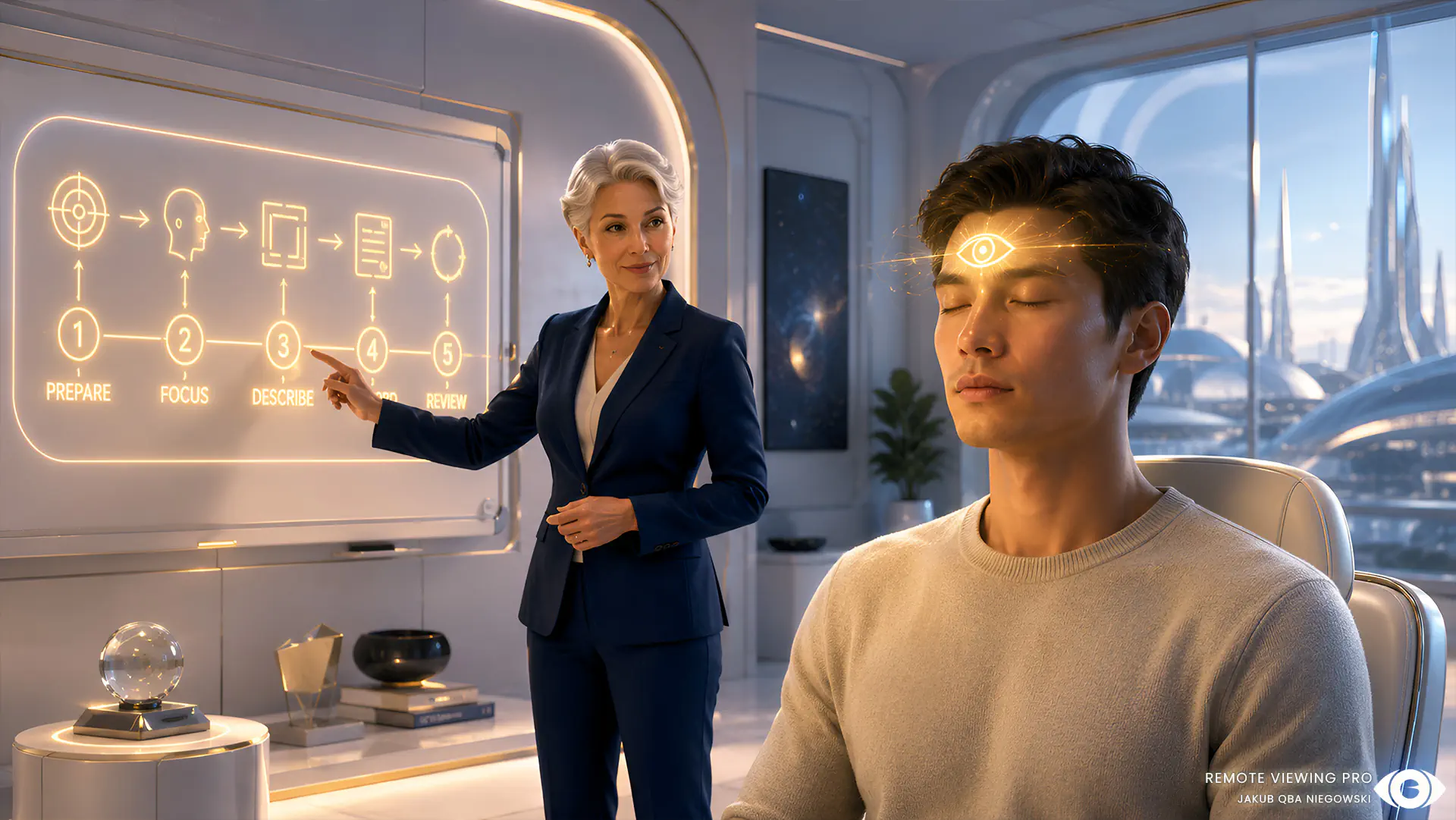
For most of human history, perceiving things at a distance was treated as a gift of the gods, a talent you either possessed or you did not. Oracles were born, not made. Seers were singled out by fate. The idea that an ordinary person could simply learn to do it, the way you learn to read music or speak a language, would have sounded absurd. And yet that is precisely what happened in the twentieth century, and it is the quiet revolution at the heart of modern remote viewing.
This shift, from rare gift to teachable skill, is the most important thing to understand if you are wondering whether you could learn this yourself. The honest answer is yes, and the reason is a story worth telling.
From rare talent to repeatable protocol
The turning point came when researchers stopped asking “who has this gift?” and started asking “how does it actually work, step by step?” Instead of hunting for prodigies, the pioneers at the Stanford Research Institute set out to map the experience itself: what a viewer does, in what order, to move from a blank start to accurate perception.
Out of that effort came structured protocols, most influentially the staged approach developed with the artist Ingo Swann. The genius of it was breaking a mysterious, intuitive act into a clear sequence that could be followed, practised, and corrected. A gift cannot be transferred from one person to another. A procedure can. The moment perception was given a reliable structure, it stopped being magic and became method – and method can be taught to anyone willing to learn.
Why a structured method changed everything
It is hard to overstate what this structure did. Without it, remote viewing is a flood of impressions hopelessly tangled with imagination, memory, and wishful thinking. The untrained mind cannot tell the faint real signal from its own loud guessing, so results are erratic and impossible to trust.
A good protocol acts like a filter and a scaffold at once. It slows you down so the genuine signal has time to surface. It separates the stages of perception so raw data is captured before the analytical mind contaminates it. It builds in checkpoints that catch the mind’s invented detail. The structure does not create the perception, but it protects it, the way a trellis does not grow the vine but lets it climb. That is why a trained viewer is reliable in a way an untrained one, however naturally gifted, almost never is.
What separates trained viewers from guessers
People sometimes assume remote viewing is just educated guessing dressed up in ceremony. The difference is stark, and it comes down to discipline. A guesser blurts the first plausible answer their mind offers, which is almost always analytical overlay, the brain’s eager attempt to label fragments before the real data has arrived. A trained viewer recognises that impulse and sets it aside, staying with the raw, strange impressions long enough for accurate information to form.
Training also teaches you to record before you interpret, to welcome feedback rather than fear it, and to read your own inner states so you know when you are perceiving and when you are inventing. These are not talents you are born with; they are skills you build through repetition under guidance. The gap between a trained viewer and a guesser is not a matter of raw ability. It is the difference between a method and a hope.
The quiet power of feedback
If there is one ingredient that turns practice into progress, it is feedback. In remote viewing, feedback means checking your impressions against the real target after the session, honestly and without flinching. This is the engine of learning. Every time you compare what you perceived to what was actually there, you calibrate your inner sense a little more finely, learning which kinds of impression to trust and which to treat with caution.
Without feedback, you are practising in the dark, reinforcing your errors as readily as your successes. With it, even your misses become useful information. This is also why the right learning environment matters so much: a structure that builds feedback into every session accelerates your growth far beyond what random solo attempts can offer.
Why self-teaching usually falls short
It is tempting to assume you can simply gather scraps from the internet and teach yourself, and I understand the appeal. But self-teaching tends to stall for predictable reasons. Without guidance, beginners rarely recognise their own analytical overlay, so they mistake their guessing for perception and never learn the crucial distinction. Without a monitor, there is no one to keep a session on track or to ask the neutral questions that draw out deeper data.
And without honest feedback, it is dangerously easy to drift into self-deception, remembering the hits and quietly forgetting the misses until you have convinced yourself of skills you have not actually built. None of this means self-study is worthless, but it explains why so many people who try to go it alone either give up in confusion or plateau early. The method was developed in a structured, monitored setting for a reason, and that setting is hard to reproduce by yourself.
What a beginner can realistically expect
So what does learning actually look like? Often, surprisingly encouraging early moments, a first verifiable impression that gives you a jolt of “wait, that worked.” Then the longer, more rewarding work of building consistency, learning to produce accurate data reliably rather than occasionally. Progress is rarely a straight line; it comes in uneven steps, with plateaus and breakthroughs, exactly like learning an instrument.
What you should not expect is instant mastery or flawless accuracy, and anyone promising that is misleading you. What you can reasonably expect, with structure and feedback, is steady, real improvement and a genuine, checkable skill that grows with practice. That honest, grounded path is far more satisfying than any fantasy of overnight powers.
Beginning where the pioneers left off
The remarkable thing about learning remote viewing today is that the hardest work has already been done for you. The trial and error, the protocol design, the decades of refinement under scrutiny – all of it is baked into the methods you can study now. You are not inventing the skill. You are inheriting it.
The best way to take up that inheritance is in a structured setting with proper guidance and feedback, the conditions the method was built for. Our live online remote viewing training gives you exactly that – real sessions, a guiding hand, and honest feedback. And to appreciate the program that turned this gift into a teachable skill, it is worth reading about the CIA’s Project Stargate.
Talent helps, but it is not the gatekeeper
None of this means that natural aptitude counts for nothing. Some people clearly take to remote viewing faster, with a feel for the signal that others have to work harder to find, just as some people pick up a language or an instrument more easily. It would be dishonest to pretend everyone progresses at the same pace. But aptitude is an accelerator, not an entry requirement, and this is the crucial distinction.
In a gift-based view, the gifted succeed and everyone else is locked out. In a skill-based view, talent simply means a slightly shorter on-ramp, while the destination stays open to anyone willing to practise with structure and feedback. The pioneers proved the second view by training ordinary people to real competence. So if you have been waiting to discover whether you have some rare spark before you begin, you have the logic backwards. You begin, and the practice reveals and develops whatever capacity you have.
Frequently asked questions
Can remote viewing really be learned, or is it a gift?
It can genuinely be learned. The pioneers transformed it from a rare talent into a structured protocol specifically so that ordinary people could be trained, and that teachable method is the basis of remote viewing instruction today.
What makes a trained viewer better than a beginner guessing?
Training teaches you to recognise and set aside analytical overlay, record impressions before interpreting them, and use feedback to calibrate your perception. These disciplines, not raw talent, separate reliable viewing from guesswork.
Can I teach myself remote viewing from free resources?
You can begin to explore alone, but self-teaching often stalls because beginners struggle to spot their own guessing and lack feedback. Guided practice with a monitor accelerates progress and prevents self-deception.
How long does it take to learn remote viewing?
Many people get encouraging early results quickly, but building consistent accuracy takes ongoing practice with feedback. Progress comes in uneven steps, and steady improvement is a far more realistic expectation than instant mastery.
Jakub Qba Niegowski – Extrasensory Consciousness Development Specialist