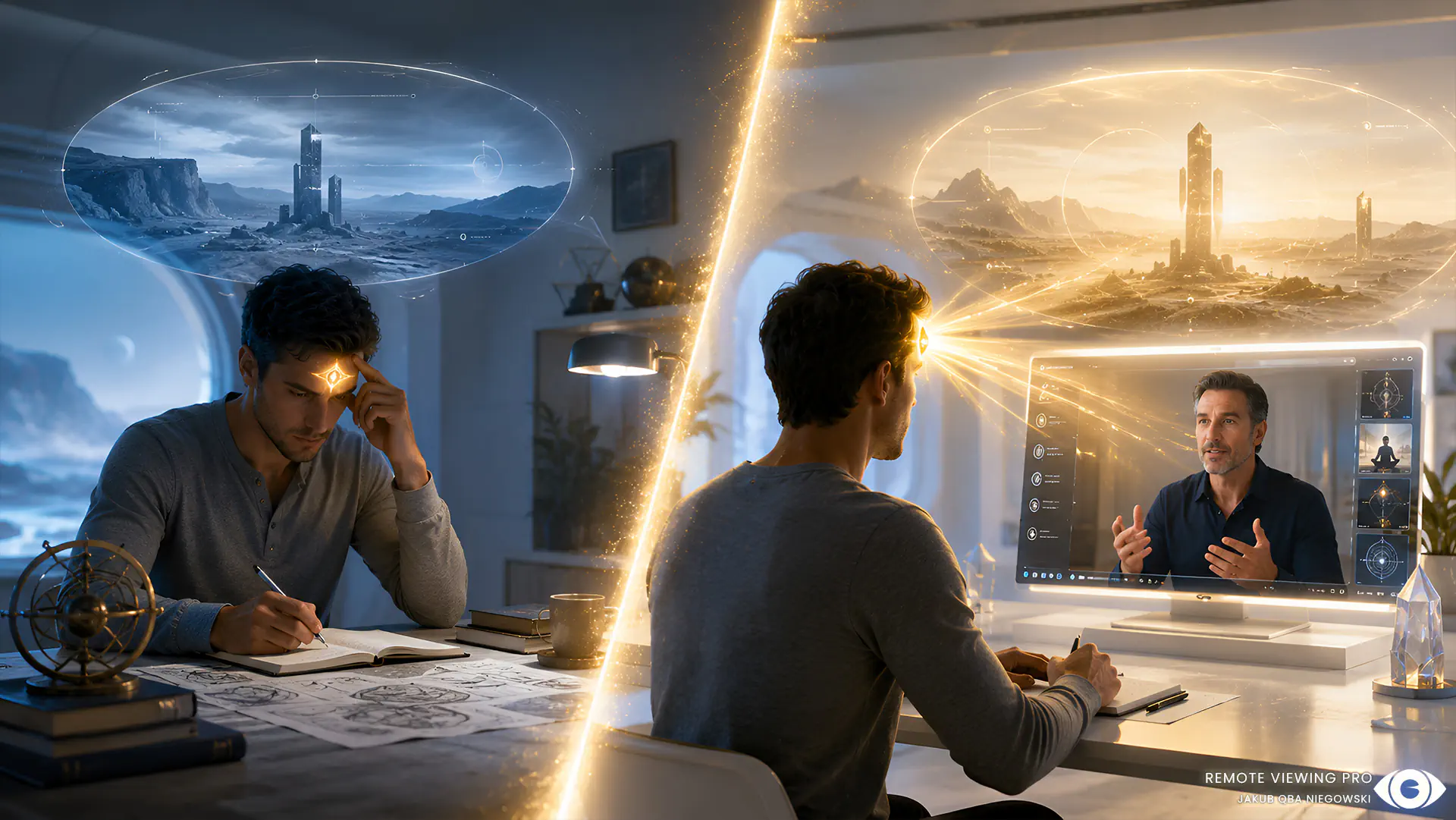

So far we have aimed remote viewing outward – at hidden bases, lost cities, distant planets. But some of the most meaningful uses of this skill point in the opposite direction, inward, toward the one target you carry everywhere: yourself. Used thoughtfully, remote viewing can become a tool for self-understanding, emotional clarity, and a deeper sense of balance in your own life.
Before we go further, an important and honest word. Nothing in this article is medical advice, and remote viewing is not a diagnostic tool or a substitute for professional healthcare of any kind. What I am describing is a practice of self-insight and personal awareness, not medicine. Please hold that distinction firmly as we explore this gentler, more personal frontier.
Turning perception inward
The same trained ability that lets a viewer perceive a distant location can be turned toward your own inner landscape. Instead of describing a building, you might explore a feeling you cannot name, a situation that has you stuck, or a quiet sense of imbalance you cannot quite articulate. Remote viewing offers a structured way to approach these inner questions with the same patient, non-judging attention you would bring to any target.
What makes this powerful is that the method is built to bypass the chattering, rationalising mind and reach something quieter underneath. Many of us are strangers to our own depths, talked over by the same analytical noise that disrupts an ordinary session. A disciplined perceptive practice can help you listen past that noise to what you actually feel and sense, which is often surprisingly different from the story you tell yourself.
Sensing the body’s signals and balance
Many practitioners describe using perception to tune into their own physical state – not to diagnose anything, but to notice the subtle signals of tension, ease, depletion, or balance that we so often ignore. In our busy lives, we override the body’s quiet messages constantly, pushing through fatigue and stress until they shout. A reflective, perceptive practice can help you notice the whisper before it becomes a shout.
This is about awareness, not medicine. Learning to sense where you are holding tension, when you are genuinely depleted, or what brings you a felt sense of balance is simply a richer form of self-attention. It can support the ordinary, healthy work of taking care of yourself – resting when you need to, noticing what nourishes you. To be absolutely clear once more: any actual health concern belongs with a qualified professional, always. This is a practice of listening to yourself, nothing more and nothing less.
Insight for self-understanding
One of the richest uses of inward viewing is plain self-understanding. We are remarkably opaque to ourselves. Our motivations hide, our patterns repeat unseen, and our real feelings often lurk beneath the ones we admit to. A structured perceptive practice can offer a fresh angle on these blind spots, surfacing insights that the ordinary thinking mind defends against or simply misses.
Approached this way, remote viewing becomes a mirror as much as a window. By turning trained, honest attention toward your own patterns and reactions, you can come to know yourself with more depth and less self-deception. This is not mystical fortune-telling about your life; it is a disciplined practice of self-reflection that uses the same core skill – perceiving what is real rather than what you assume – applied to the territory of your own mind.
Clarity for emotional and life questions
Life is full of questions that resist pure logic. Why does this situation keep unsettling me? What do I actually want here, beneath what I think I should want? What is really going on in this relationship or this choice? These are not problems a spreadsheet can solve, and the rational mind often just spins in circles around them.
A reflective viewing practice can bring a different kind of clarity to such questions, helping you perceive the emotional textures and quiet truths that ordinary thinking talks over. It will not hand you a tidy verdict, and it should not replace the counsel of trusted people or professionals when those are needed. But as a way of sitting with a murky personal question and listening for what you genuinely sense beneath the noise, it can be quietly illuminating, and many practitioners find it one of the most personally valuable things the skill offers.
Why a trained, grounded approach matters
Inner work carries a particular risk that outer targets do not, and it deserves real honesty. When you turn perception toward your own emotionally charged questions, the temptation to find the answer you want – or to fall into the answer you fear – is enormous. Your hopes and anxieties can flood the session far more easily than they would when you are describing a neutral building. This is exactly where untrained inner work can mislead rather than illuminate.
This is why a grounded, trained approach matters so much for self-insight. The discipline of separating genuine perception from wishful thinking or anxious projection is the whole skill, and it is even more important when the target is your own heart. A trained viewer learns to hold their inner questions with the same honesty and non-attachment they would bring to any target, which is what keeps the practice clarifying rather than self-deceiving. Stability and groundedness are not optional extras here; they are what make inner viewing safe and useful.
The deeper gift: a more aware life
Step back from any single application and a larger benefit comes into view. The habits that inward viewing cultivates – patient self-attention, honesty about what you actually feel, the discipline of listening past your own noise – are the very habits of a more aware and grounded life. Even if you never run a formal session about a personal question, learning remote viewing tends to make you more present to yourself.
Practitioners often report that the skill quietly improves their relationship with their own inner world. They become better at noticing their states, less driven by unexamined reactions, more able to pause and perceive before they assume. That growing self-awareness is, for many, the most lasting reward of the entire practice, worth more than any dramatic external hit.
Where self-insight fits in the bigger picture
Using remote viewing for wellbeing and self-understanding is one of its gentlest and most personal applications. To see the full range of what the skill can do, it is worth reading my overview of what you can do with remote viewing.
If the idea of turning trained perception inward, for clarity and self-awareness, speaks to you, the foundation is the same disciplined skill that underlies every application. Our live online remote viewing training gives you that grounded foundation, so you can explore your inner landscape from a place of stability and genuine skill rather than guesswork.
A gentle practice, not a fix
One more word of care, because inner work invites a particular kind of overreach. Remote viewing for self-insight is best held as a gentle, ongoing practice rather than a problem-solving machine you turn to in crisis demanding answers. The moment you approach your own heart with desperation, the clarity you seek tends to dissolve, replaced by whatever you most hope or fear to find.
So treat inward viewing as a slow, kind form of self-attention, something that deepens over time rather than delivering verdicts on demand. It sits alongside the other healthy things you do for yourself, never replacing rest, connection, or professional support when those are what you genuinely need. Held lightly and patiently, it becomes a quiet companion to a more aware life, which is exactly the spirit in which it serves you best.
Frequently asked questions
Can remote viewing be used for wellbeing?
It can support self-awareness, emotional clarity, and a richer sense of your own balance, used as a reflective practice. It is not medicine or a diagnostic tool, and it should never replace professional healthcare for any genuine health concern.
Can remote viewing diagnose health problems?
No. Remote viewing is not a diagnostic tool and nothing about it is medical advice. It may help you notice subtle signals of tension or balance as a form of self-attention, but any health concern belongs with a qualified professional.
How does remote viewing help self-understanding?
By turning trained, honest attention inward, it can surface insights about your patterns, feelings, and blind spots that the rationalising mind often defends against. It works like a mirror for disciplined self-reflection rather than fortune-telling.
Why does inner viewing need a grounded approach?
Because your hopes and fears can easily flood an emotionally charged session, the discipline of separating real perception from wishful thinking is essential. A trained, stable approach keeps inner viewing clarifying rather than self-deceiving.
Jakub Qba Niegowski – Extrasensory Consciousness Development Specialist