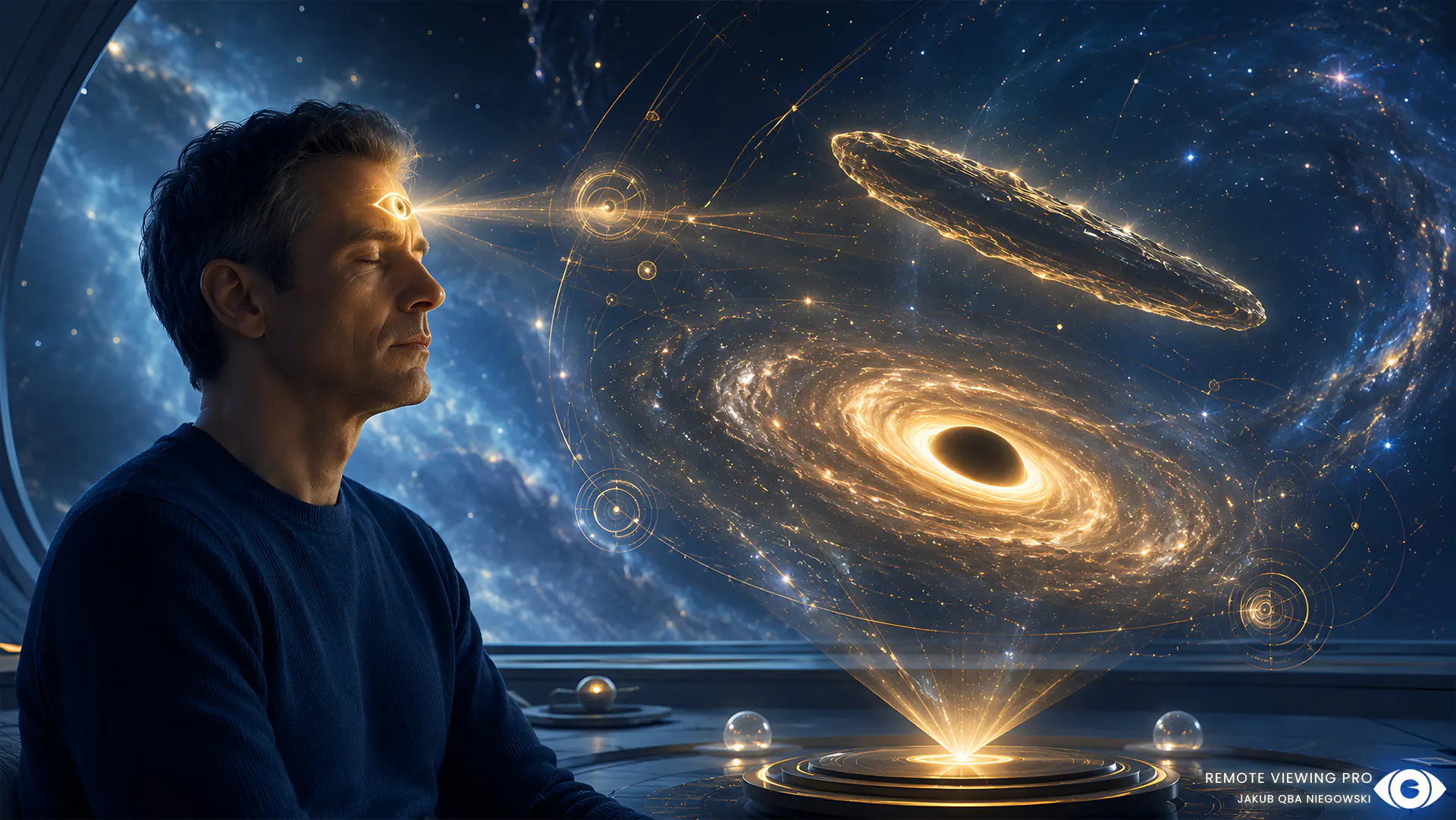

Humanity has always longed to reach the stars. We have sent probes across billions of miles, built telescopes that peer to the edge of the universe, and dreamed of walking on other worlds. Yet there is one explorer that may have reached further than any spacecraft, faster and at no cost at all: the human mind. The idea that remote viewing can perceive distant planets and the depths of space is among the most awe-inspiring claims in the entire field, and it rests on a genuinely famous case.
This is where remote viewing stops feeling practical and starts feeling cosmic. Let me take you to the outer planets and beyond, and explore what it might mean that perception itself could be humanity’s farthest-reaching instrument.
Reaching targets no probe can visit
Space presents the ultimate challenge of distance, the very thing remote viewing seems strangely indifferent to. A spacecraft takes years to reach the outer planets and may never return. Vast regions of the cosmos will never be visited by any machine we can build in our lifetimes. But if perception is not bound by distance in the way bodies are, then in principle no target is too far – not Jupiter, not the edge of the solar system, not the strangest objects in deep space.
This is what makes space such a tantalising frontier for remote viewing. It offers targets that are otherwise utterly unreachable, places we can study no other way. The mind, costing nothing and travelling instantly, becomes a kind of explorer that goes where no probe can follow. Whether or not you find the claim easy to accept, the ambition of it is breathtaking, and it has a real, documented case at its heart.
Swann’s Jupiter and the outer planets
The cornerstone of cosmic remote viewing is the famous Jupiter experiment. In 1973, before any spacecraft had reached the giant planet, the gifted viewer Ingo Swann set out to perceive Jupiter as part of the research at the Stanford Research Institute. What he reported was remarkable, including a description of a ring of particles encircling the planet – something astronomers of the day considered absurd, since Jupiter was not thought to have rings.
Six years later, when NASA’s Voyager spacecraft swept past Jupiter, it confirmed the existence of a faint ring system, along with other features Swann had described. The match between his 1973 impressions and the later spacecraft data became one of the most cited cases in the history of remote viewing. Skeptics debate the precision of individual details, and that debate is fair. But the core fact endures: working from a chair on Earth, a viewer described a feature of a distant planet that science had not yet discovered. That single session opened the cosmic frontier.
What viewers report about other worlds
Swann’s Jupiter session was not the end of it. Remote viewers have turned their attention to other planets, moons, and distant locations across the solar system and beyond, reporting impressions of landscapes, atmospheres, structures, and conditions on worlds no human will ever touch. These accounts range from the scientifically suggestive to the frankly strange, and honesty requires holding them with both wonder and caution.
Some impressions of planetary environments have intriguingly echoed what later exploration revealed; others remain unverifiable, describing things we have no way to confirm. I think the right posture is open-minded curiosity rather than either blind belief or flat dismissal. Where a viewer’s description of a world can be checked against later data, the hits are worth taking seriously. Where it cannot, the impressions remain fascinating but unproven. The cosmic targets are, by their nature, the hardest to confirm, which is exactly why the verifiable Jupiter case matters so much.
The mind as humanity’s farthest explorer
There is a thought here that genuinely moves me. We tend to picture exploration as a matter of rockets and rovers, of physical machines crawling across alien ground. But if remote viewing is real, then the most far-reaching explorer we have is not built of metal at all. It is consciousness itself, capable of reaching across the solar system in an instant and returning with impressions of places light itself takes hours to cross.
This reframes what a human being is. It suggests that locked inside each of us is an instrument of exploration whose reach may dwarf anything we can engineer. The same faculty that lets a trained viewer describe a building across town might, at full stretch, brush against the rings of a distant planet. Whether or not every cosmic session is accurate, the very possibility expands your sense of what the mind – your mind – might be capable of. That expansion is, to me, the real gift of this application.
Why the cosmic cases are hard to verify
Intellectual honesty demands that I dwell on the obvious difficulty. Most space targets cannot be checked. We cannot dig at Marea to confirm a description, or wait for a satellite to photograph a secret base. When a viewer describes the surface of a distant moon, we usually have no way to know whether they were right. This makes cosmic remote viewing the most speculative branch of the whole field.
That is precisely why the Jupiter case carries such weight. It is one of the rare instances where a cosmic impression was recorded in advance and later checked against hard data from a spacecraft, and it held up on a key, surprising point. The verifiable cases are the anchor; the unverifiable ones are the open horizon. A thoughtful explorer keeps the two clearly separate, treasuring the confirmed hits while holding the rest as wonder rather than fact.
What space viewing offers the curious
Even if you never attempt to view a distant planet yourself, the cosmic dimension of remote viewing offers something valuable: a radical expansion of what you believe is possible. It invites you to consider that the universe might be far more accessible to the mind than we have ever been taught, and that the boundary between you and the farthest reaches of space may be thinner than it appears.
For many practitioners, that expanded sense of possibility is inspiring in itself. It turns the night sky from a distant spectacle into something you might, in some small way, be able to reach. Whatever the ultimate truth of the most ambitious cosmic sessions, the wonder they evoke is real, and wonder has a way of drawing people deeper into the practice and into a larger sense of their own potential.
Where space viewing fits in the bigger picture
Reaching toward space and distant planets is the most epic branch of remote viewing’s many uses. To see the full range of what the skill can do, it is worth reading my overview of what you can do with remote viewing.
If the cosmic reach of the mind has captured your imagination, the journey to the stars begins with learning the fundamentals here on Earth. Our free remote viewing eBook introduces the foundations, the same grounded skill that, taken to its limits, once described the rings of Jupiter before any spacecraft confirmed them.
Beyond the planets, toward the truly unknown
The solar system is only the beginning of the cosmic frontier. Some viewers have turned their attention toward far stranger and more distant targets – the enigmatic objects of deep space, anomalies that telescopes can barely glimpse, regions of the universe no probe will ever approach. These are the ultimate unreachable targets, and they push the very idea of perception to its limits.
I treat this outer edge with the most caution of all, since almost nothing here can be verified. Yet there is something fitting about the mind reaching toward the deepest unknowns, the places where even our greatest instruments fall silent. Whether or not these far-flung sessions can ever be confirmed, they express the boundless curiosity that draws people to remote viewing in the first place – the refusal to accept that anything, anywhere, is truly beyond the reach of an attentive mind.
Frequently asked questions
Can remote viewing perceive distant planets?
The most famous case is Ingo Swann’s 1973 session describing features of Jupiter, including a ring, six years before Voyager confirmed it. Viewers have attempted other cosmic targets, though most cannot be verified the way Jupiter eventually was.
What did Ingo Swann see on Jupiter?
He described features including a ring of particles around the planet, which astronomers then thought impossible. When Voyager reached Jupiter in 1979, it confirmed a faint ring system and other details he had reported years earlier.
Is remote viewing of space scientifically proven?
It is the most speculative branch of the field, because most space targets cannot be checked. The Jupiter case is compelling because it was recorded in advance and later confirmed, but many cosmic impressions remain fascinating yet unverifiable.
Why is space remote viewing so inspiring?
Because it suggests the mind may reach where no spacecraft can, instantly and at no cost. It reframes consciousness as humanity’s farthest explorer and expands your sense of what your own perception might be capable of.
Jakub Qba Niegowski – Extrasensory Consciousness Development Specialist