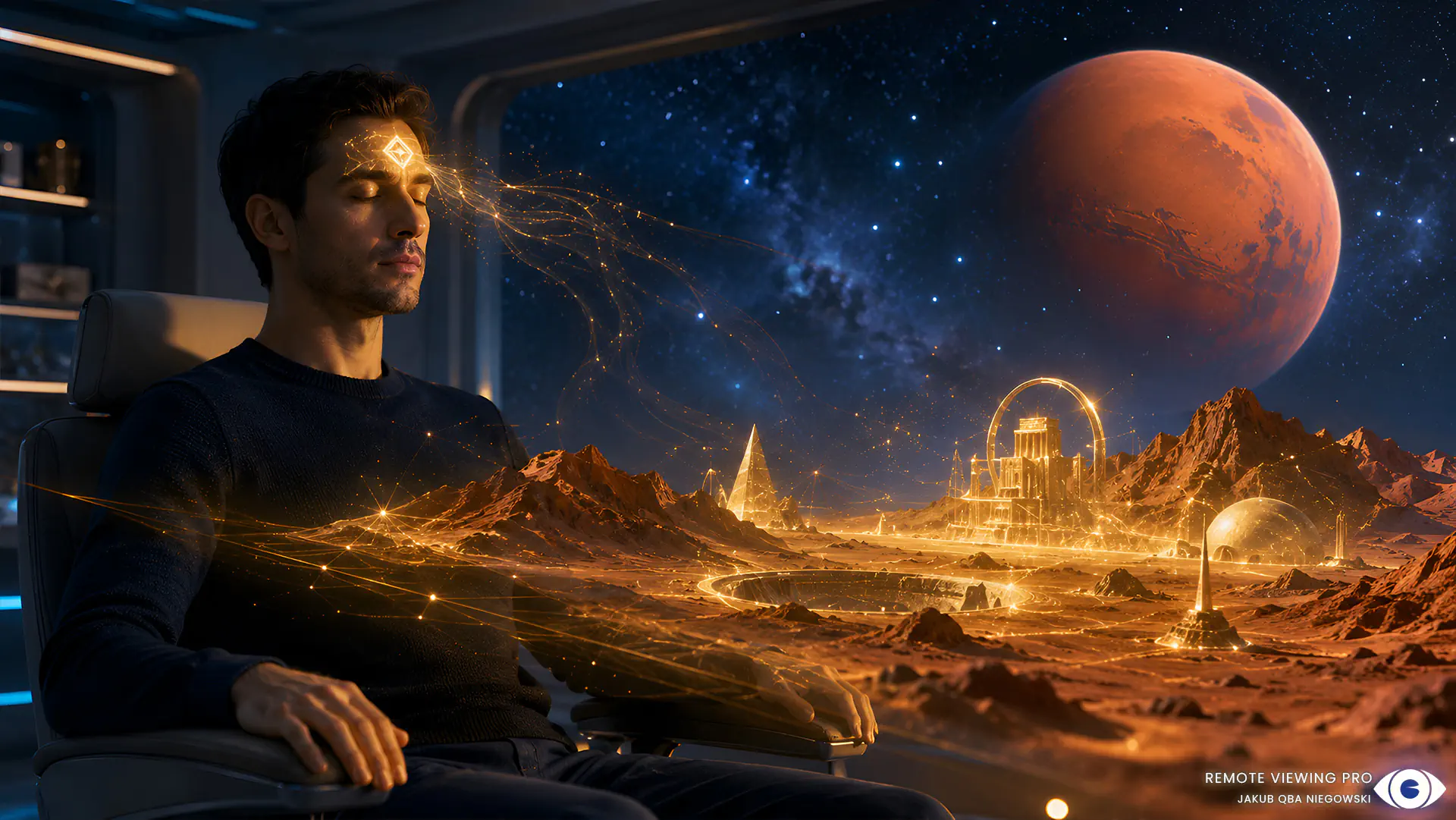
In the spring of 1984, a trained remote viewer sat in a quiet room, handed nothing but a sealed envelope and a set of coordinates. He did not know where he was being sent. What he described over the next hour was so extraordinary that, decades later, the declassified transcript still fascinates and unsettles people in equal measure. The target, revealed only afterward, was the planet Mars, roughly a million years in the past. This is one of the strangest and most famous sessions in the history of remote viewing, and it deserves to be told with both wonder and honesty.
Let me walk you through what actually happened, what was reported, and how to think about a case like this without either swallowing it whole or dismissing it out of hand.
The famous Mars tasking and its results
The session was conducted within the United States government’s remote viewing program, with the experienced viewer Joseph McMoneagle. The protocol was strict and blind. McMoneagle was given only geographic coordinates inside a sealed envelope, along with a spoken instruction to perceive the location at a point deep in the past. He was not told it was Mars. He was not told anything that could shape his impressions. This blindness is crucial, because it is what makes the session more than an exercise in imagination.
The coordinates pointed to a now-famous region of Mars, and the time was set to roughly a million years ago. What McMoneagle reported was not empty rock and dust. He described a landscape and, within it, signs of a civilisation: enormous pyramidal structures, tall thin figures, and a sense of a people facing some kind of catastrophe. It reads like science fiction, and yet it emerged, on the record, from a blind session run under serious protocol.
Structures, landscapes and beings described
The detail in the transcript is what gives it its haunting quality. McMoneagle described towering pyramid-like constructions and other massive features set into the Martian terrain. He perceived violent weather, great storms sweeping the landscape. And most strikingly, he described inhabitants: very tall, very thin beings, whom he sensed were ancient even in that distant time, and who seemed to be sheltering or struggling against an environment turning hostile.
He sensed a civilisation in decline, a people aware that their world was failing, perhaps seeking to survive or escape. Whatever you make of it, the account is vivid, coherent, and emotionally resonant in a way that raw guessing rarely is. It is not a list of random shapes; it is the description of a world and its inhabitants in their final age. That coherence is part of what makes the session so memorable, and so difficult to simply wave away.
Comparing impressions with what we know
Here honesty must take the wheel, because this is where credibility is won or lost. The region McMoneagle was tasked with includes the area made famous by the so-called Face on Mars, a formation photographed in the 1970s that many thought looked artificial. For years it fuelled speculation about Martian civilisations. But later, higher-resolution imagery from more advanced spacecraft showed the Face to be a natural mesa, a trick of light and low-resolution cameras. The mainstream scientific verdict on artificial structures at this site is clear: there is no confirmed evidence of them.
So how do we weigh the session against that? Plainly: McMoneagle’s Mars impressions are unverifiable. We cannot travel a million years into the Martian past to check them, and the modern evidence does not support artificial structures there today. The session is a documented historical record of what a viewer perceived, not proof of an ancient Martian civilisation. Holding that line is essential. The transcript is real and remarkable; the reality of what it describes remains entirely unconfirmed.
Why the session still fascinates
If it cannot be verified, why does this case endure? Because of the conditions under which it was produced. A skilled viewer, working blind, with no knowledge of the target, generated a detailed, internally consistent account of a specific place and time. That does not prove the content is true, but it does make the session genuinely puzzling. Where did such a coherent narrative come from, if not from some form of perception?
Skeptics reasonably answer that the human mind is a brilliant storyteller, capable of weaving a vivid tale from a vague prompt and a dramatic instruction. That is a fair and serious explanation, and it may well be correct. The honest position acknowledges the puzzle without pretending to have solved it. The Mars session sits in that uncomfortable, fascinating space between a remarkable perception and an elaborate act of imagination, and intellectual honesty means being willing to live in that uncertainty.
An invitation to wonder, not belief
I think the right response to the Mars session is wonder rather than belief or dismissal. It invites us to sit with a genuinely strange artifact: a declassified government document in which a trained viewer described an ancient civilisation on another planet. You do not have to believe a word of the content to find that remarkable as a human and historical curiosity.
What the case should not do is become a doorway to credulity, where every wild claim about Mars gets dressed up in the authority of remote viewing. The discipline that makes this field worth taking seriously is precisely the willingness to say, clearly, this is unverified. Approached that way, the Mars session becomes an invitation to wonder about the reach of perception and the mysteries of the cosmos, held with an open but careful mind.
What the Mars case teaches about remote viewing
Beyond Mars itself, the session illustrates something important about the practice. It shows both the tantalising reach of remote viewing, its willingness to be pointed at literally any target across space and time, and the hard problem of verification that haunts its most dramatic applications. The further a target lies from anything we can check, the more the results become fascinating but unprovable.
This is why serious practitioners value verifiable targets so highly, the ones where impressions can be matched against reality. Cases like Mars are the spectacular, untestable edge of the field, thrilling to contemplate but impossible to confirm. Understanding that spectrum, from the checkable to the purely speculative, is part of becoming a mature and credible viewer rather than a collector of marvels.
Where the Mars session fits in the bigger picture
The Mars tasking is one of many extraordinary case studies that show how far remote viewing has been pushed. It belongs alongside other great mysteries that draw the perceiving mind, from ancient monuments to the deep unknowns of space. To explore the heart of these case studies, it is worth reading about remote viewing the Great Pyramid of Giza, another target where wonder and discipline must be held together.
And if a cosmic or historical mystery captivates you and you would like it explored through trained perception, that is specialised work for an experienced viewer. You can request a session from a trained remote viewer, approached with the honesty and rigor that such speculative targets demand.
What the viewer himself says
One detail elevates this case above the sensational headlines it usually attracts: the viewer’s own restraint. McMoneagle has never claimed the Mars session proves an ancient Martian civilisation. He has spoken about it with notable caution, acknowledging that he has no way to verify what he perceived and treating the content as a striking but unconfirmed experience rather than a revelation. That humility from the very person who produced the session is, to me, a mark of credibility.
It is worth contrasting his measured stance with the breathless way the case is often retold online, where the same transcript becomes proof that the government confirmed life on Mars. It confirmed nothing of the kind. The honest position mirrors the viewer’s own: a remarkable, documented session whose content cannot be checked. When the person with the most to gain from belief is the most careful, that tells you something about how the subject deserves to be handled.
Frequently asked questions
Did a remote viewer really describe ancient Mars?
Yes. In a documented 1984 session within the government program, viewer Joseph McMoneagle, working blind from sealed coordinates, described pyramidal structures, storms, and tall thin beings on Mars about a million years ago. The transcript was later declassified.
Is the Mars remote viewing session proof of life on Mars?
No. The impressions are entirely unverifiable, and modern high-resolution imagery shows no confirmed artificial structures. The session is a remarkable documented record of what a viewer perceived, not evidence of an actual Martian civilisation.
What about the Face on Mars?
The Face was a 1970s formation that looked artificial in low-resolution photos. Later, sharper imagery revealed it to be a natural mesa. Mainstream science finds no confirmed artificial structures in that region of Mars.
How should I think about the Mars session?
With wonder rather than belief or dismissal. It is a genuinely puzzling artifact produced under blind conditions, but its content cannot be confirmed. The honest stance holds it as fascinating and unverified at the same time.
Jakub Qba Niegowski – Extrasensory Consciousness Development Specialist